November 12, 2009

Bike Parking Design

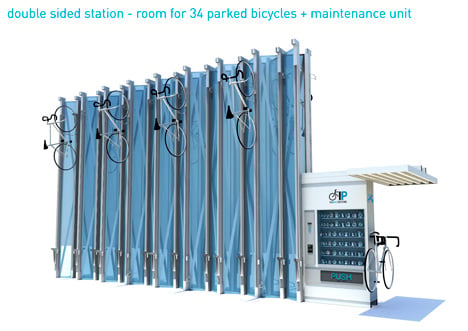
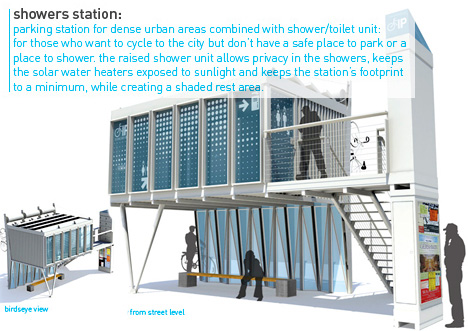
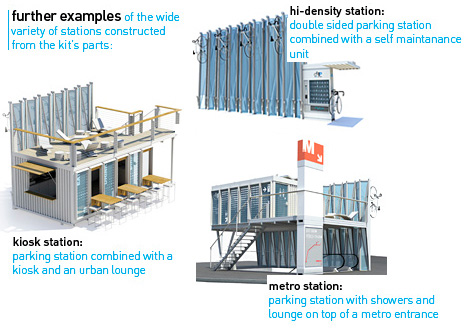
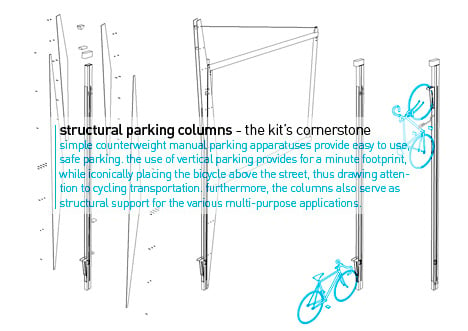
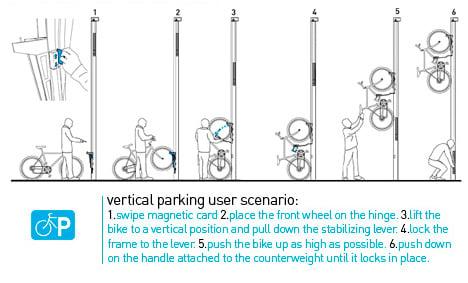
Interesting new concept parking designs from Desiner Yinnon Lehrer


November 11, 2009

Re-Cycling


A friend of mine found a mint-condition mountain bike on a skip near his house recently – a prime example of “throwawayism”. According to Social Entrepreneur Ireland award winner Anne Bedos, it’s quite common for people to throw good bikes away. Rather than just get mad about it, Bedos decided to do something – she believes that salvaging abandoned bikes is an environmental imperative, and can also be used as an instrument of social change.
Her bicycle recycling organisation Rothar saves bikes from the scrap heap and works with at-risk people from Dublin youth groups to fix them up. The spruced-up bikes are then sold at a community-based bicycle shop, typically for less than €100. Genius.


Vélib Thievery


Vélib, the Parisian bike-sharing program, is great. But it would be incorrect to pretend that tout est parfait dans le meilleur des mondes (lit. transl.: everything is perfect in the best of worlds). Vandalism and theft has been a problem, and the latest news aren't good: About 80% of the original 20,600 bicycles have been damaged or stolen and the resources required to fix them or replace them are straining the program's budget. There's even a black market for stolen Vélib bikes in Eastern Europe and Africa...


The NYT writes:
Many of the specially designed bikes, which cost $3,500 each, are showing up on black markets in Eastern Europe and northern Africa. Many others are being spirited away for urban joy rides, then ditched by roadsides, their wheels bent and tires stripped.
The first thing that jumps at me is the reported cost of the bikes. Maybe the New York Times has bad information, but if the bikes really cost that much, that's probably the first thing that should be changed.
JCDecaux must repair some 1,500 bicycles a day. The company maintains 10 repair shops and a workshop on a boat that moves up and down the Seine.JCDecaux reinforced the bicycles' chains and baskets and added better theft protection, strengthening the mechanisms that attach them to the electronic parking docks, since an incompletely secured bike is much easier to steal. But the damage and theft continued.

There will always be a certain amount of vandalism (especially if France doesn't solve its problem with the alienation of the banlieues), but using such expensive bikes makes them a much bigger target for thieves who want to make a buck, and they inflate the replacement costs, making the whole scheme a lot less profitable (and thus sustainable) than it could otherwise be. It must be possible to make rugged bikes for less than that...
In some areas, it can be hard for would-be cyclists to find working bikes. But despite these problems, Vélib has had 63 million rentals since mid-2007 and surveys show that Vélib users are still happy with their experience.
It will be very interesting to see if, as other bike-sharing programs grow, they attract the same kind of problems as Vélib or if this is more of a specifically Parisian problem.

Via NYT + Treehugger


London - Paris Cycle Route


London-Paris cycle route planned for 2012


AFP - A cycle path linking London and Paris will be completed by 2012, French and British local authorities said here on Friday as they formally launched the "Avenue Verte" (Green Avenue) project.
"We want to symbolically link the Tower of London to the Eiffel Tower with an alternative mode of transport to the car that crosses landscapes of great quality," said Didier Marie, head of France's Seine-Maritime department.


The 350-kilometre (218-mile) "Avenue Verte" will use existing national cycle network routes in southern England, passing through the counties of Surrey and Sussex.


Cyclists will need to take a ferry across the Channel from Newhaven to Dieppe.


In France, the cycle path will follow a route through Normandy as it winds its way south to Paris.
The route will incorporate stretches of disused railway lines as well as using regular roads where cycles will have their own dedicated lanes.


"These (existing dedicated cycle paths) were built for tourism but we quickly noticed they were being used by people going to work," said Matthew Lock, a local councillor from the English county of East Sussex.


Amphibious Velomobile


From an ambitious inventor in the Czech Republic, we bring you the HEPAV — the Human Powered Electric Amphibious Vehicle.
How does it work? Simply put, the HEPAV 1.1 is a recumbent tricycle with electric assist and a buoyant shell that allows riders to drive directly into and out of ponds, rivers and lakes. Inventor David Buchwaldek says he designed the HEPAV 1.1 to be like a kayak in that it can be transported by vehicle but ridden directly into the water. Video proves the viability of Buchwaldek’s design, but it remains unclear how practical it is. The HEPAV 1.1 seems pretty slow in the water at this point.

Unfortunately, the HEPAV 1.1 is still far too expensive to build to be commercially viable, but that may not be the point of the vehicle. Buchwaldek’s process and thinking is enlightening in itself and worth a trip to his website,esoteric-david.eu. Among other projects documented there are a human-powered airplane, an innovative bike rack available for purchase, and appropriately ‘esoteric’ advice like Life Tips and Tricks #25. “Progress is the realization of utopias.”


Share Space

In the German town of Bohmte, the highway code has been abolished in order to create a common code to cardrivers, cyclists and pedestrians. (Report: B. Boussouar)


Via France24

Innovative Fold-Up


Innovations in folding bikes have helped urban cyclists cram their vehicles into tiny apartments for years now--and the designs keep getting better and better, and smaller and smaller. And this new folding bike concept by Victor Aleman may take the cake--as you may or may not be able to tell, even the wheels fold up on this bad boy. More pics after the jump.


Via Tuvie


Sceptic about Electric Cars

You should be, Electric Cars will not be dramatically cleaner than those powered by fossil fuels until they rely less on electricity produced from conventional coal-fired plants, according to US National Research Council.


“For electric vehicles to become a major green alternative, the power fuel mix has to move away from coal, or cleaner coal technologies have to be developed,” said Jared Cohon, chair of a US National Research Council report released this week entitled Hidden Costs of Energy: Unpriced Consequences of Energy Production and Use.
About half of US power is generated by burning coal, which emits many times more of traditional pollutants, such as particulates and smog components, than natural gas, and about twice as much of the main greenhouse gas carbon dioxide.
Advances in coal burning, like capturing carbon at power plants for permanent burial underground, could also help electric cars become a cleaner alternative to vehicles powered by fossil fuels, he said.
Pollution from energy sources did $120 billion worth of damage to human health, agriculture and recreation in 2005, said the NRC report, which was requested by the US congress in 2005 and sponsored by the US department of the treasury.Electricity was responsible for more than half of the damage.
Electric cars have other benefits such as reducing imports of foreign oil. But they can have hidden costs. Materials in electric car batteries are hard to produce, which adds to the energy it takes to make them. According to the report, the health and environmental costs of making electric cars can be 20 per cent greater than conventional cars, and manufacturing efficiencies will have to be achieved in order for the cars to become greener.
Emissions from operating and building electric cars in 2005 cost about 20 cents to 15 cents per mile traveled, it said. In comparison, gasoline-powered cars cost about 0.34 cents to $5.04 per mile traveled.
The report estimated electric cars could cost more than gasoline-powered cars to operate and manufacture in 2030 unless power becomes cleaner.

"Our research has shown that on average our electric vehicles' 'well to wheel' lifecycle emissions are 59 per cent lower than petrol cars. But in France, where electricity is primarily generated using nuclear, emissions are 97 per cent lower," he argues.

Hybrid gasoline-electric vehicles with batteries charged by the driver braking scored slightly better than both gasoline-powered cars and plug-in hybrids, which have batteries that are charged by the power grid.
– Reuters
Biking in NYC

NYC DOT explains Bike Lanes in the Big Apple


Bike lanes: In some cities people are literally dying to have them and some people go so far as to mark their own. Here in New York City, it feels like every time I get on my bike there is a new bike lane - sometimes on the left, sometimes buffered, and sometimes completely separated from automobile traffic. To understand these lanes, I had the opportunity to go for a ride with the NYC DOT bicycle boys. They explained the classes of bike lanes and showed off some of these inventive facilities. You can use Ride the City to find a safe bike route in New York City and watch this video to see what lanes are used on your route.

New Audi Ad

What are you talking about Audi, I love cycling in the rain!