
 |
| Annie Scheel |
Showing posts with label urban design. Show all posts
Showing posts with label urban design. Show all posts
January 27, 2011
Cycle Parking Lot
January 19, 2011
Urban Mobility Beyond the Car

As part of the MaHS/MaUSP programme at KU Leuven, ecourb was involved in a project looking at 'Urban Mobility Beyond the Car'. We decided to create a comic book, in the style of the 'Yes is More' archicomic published last year by BIG. The results of this comic are shown here.
December 5, 2010
New Bicycle Path, LISBOA
 |
| © João Silveira Ramos |
Here is a wonderful project with the promotion of urban cycling at its core, while at the same time improving the quality of urban space along the river banks of the Tagus in Lisboa. The remarkable thing about this project is the minimal interventions used, no expensive paving here, just a really nice graphic language deployed onto urban surfaces. I can't help but be reminded on Caruso St. John's wonderful Bankside Directional Signage System in London. Simple, Everyday Urbanism.
November 7, 2010
Urban Mobility Beyond Cars: Dublin

Ecological Urbanism is delighted to announce that my research proposal 'Urban Mobility Beyond Cars" has recently been shortlisted for a research competition organised by the Royal Institute of the Architects of Ireland. The competition,
3Twenty10, was a call for Irish Architects to identify solutions to the challenges facing Ireland’s built environment in the aftermath of the boom years. It explores how the profession can contribute to the wider debate about national recovery.
August 10, 2010
The Cities of China
 |
| image: chinographics |
And the numbers are only growing. According to the McKinsey Global Institute, Chinese cities are expected to add more than 350 million people by 2030 - that's the entire population of the United States today - which will bring their urban-dwelling population to more than a billion. By then, China will have more than 220 cities with populations of more than a million, and 24 megacities with more than five million inhabitants.
More at worldchanging
July 9, 2010
Copenhagen Cycling Superhighways
This is a great news video from current.tv's series on 'Urban Mobility- Rethinking Transportation in an Urban Environment.
Voted the world's most livable city in 2008, Copenhagen embraces bicycle culture as part of daily life with nearly 40 % of residents riding a bike to work. Blogs and fashion photos are dedicated to bike style, and throughout the city you'll find bicycle bars on sidewalks so riders can rest their feet; green lights that change early for cyclists; and even friendly signs greeting "Hi Cyclist!"
It's no wonder then that Copenhagen is innovating new ways of creating a bike-friendly city with a system of as many as 15 extra-wide, segregated bike routes connecting the suburbs to the center of the city. Technological advances will soon follow, so commuters can detect other riders on the routes, and help them to assemble into pelotons or "bike buses." These groups could in turn emit signals that trip traffic lights in their favor, resulting in a "green wave" of bicycle momentum.
May 24, 2010
Reclaiming the Banks of the Seine
 |
| Port de Solferino - left bank © Apur / JC Chobelet Paris mayor Bertrand Delanoë - who introduced Paris-Plages, when the banks of the Seine become a temporary beach every summer - said that removing cars all year round from sections of the riverbank would help cut pollution and boost the capital's international standing. Up to 70,000 cars travel daily along the Seine's left bank and what is known as the Pompidou expressway – a dual carriageway along the right bank built in 1967 by Mr Pompidou , an avid motorist who declared: "The French love their cars". The banks have been UNESCO world heritage sites since 1992. |
April 28, 2010
Cyclize your city
 |
| Image by Daniel Peeters |
The winner will receive EUR1,000 and the opportunity to see their work used in a nationwide campaign promoting the development of cyclized cities in Ireland. The winner along with 20 of other entries will be displayed as part of a 'Cyclised' art show in Gallery Number One for the duration of Bike Week where the winner will be announced on the 17th of June at an evening award ceremony. The show wil then travel around Ireland to help with the nationwide cycling awareness campaign.The winning entry will be on public display on a variety of billboards throughout Dublin city for three weeks after Bike Week finishes on the 20th of June.
April 16, 2010
The Future Of Urban Mobility
Keep an eye on current.com/urbanmobility for more videos over the next while and remember that the future is mobilized.....
February 22, 2010
Innovative Bicycle Storage Solutions from Andrew Lang
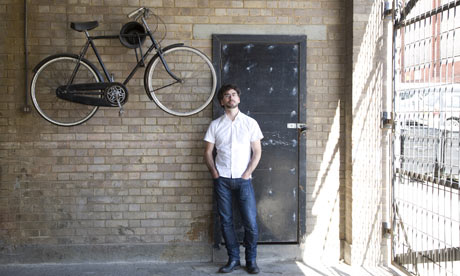 |
| Andrew Lang, designer of Cycloc Photograph: Luke Hayes/guardian.co.uk |
The theory that states that the simplest ideas are the best is proved in spades by the Cycloc – the brainchild of product and industrial designer Andrew Lang. That's not to undervalue its genius, which delivers a practical solution with an injection of edgy art installation style. So, what exactly is it? Put simply, the device is a cycle storage solution that dexterously solves the problem of bike storage in confined spaces.
February 15, 2010
Kolelinia / Martin Angelov

February 5, 2010
Cities for the people | Jan Gehl, Gehl Architects

Jan Gehl graduated from Architecture in 1960, a time to him represents an all time low point in city planning, when architects were big and people were quite small. After marrying a psychologist he started questioning why architecture solely focused on form and did not focus at all on people? For Jan Gehl, Architecture is the interaction between form and life. Cue Jan Gehl’s one stone, five birds policy. If you are sweet to people it is possible to create Lively, Attractive, Safe, Sustainable, and Healthy cities. Modernism, one of the evil of society according to Mr. Gehl, interpreted cities as bad and buildings as good. 1960, the year he graduated was also the year when post-war reconstruction started big time. At the same time there was an invasion on the city ten years after the war, the car invasion. Of course cheap petroleum fuelled this and all the city planner’s energy went into trying to make the car happy. Using Westport, a small town in the west of Ireland as an example, he argues that as a result of the car invasion, human dignity was being eroded. The ideologies of modernity need to be broken.
January 29, 2010
Harmony City
If only China was so perfect. Remind me how ARUP's Dongtan Eco-city went again? That's right, down the toilet. Maybe there should be more focus on preserving the existing cities and existing cycling culture and integrating them into future development as opposed to simply bulldozing centuries of culture and tradition and quality vernacular architecture and sustainable urban form. Not to mention the uprooting of many thousands of people from their family homes. Then they wouldn't have the problems creates by the many 'harmony' cities that are popping up everywhere. Then they wouldn't have to ban avatar from their movie theaters. China's interpretation of Harmony is very strange indeed.
Via IDEO's Living Climate Change
January 28, 2010
Emerging City Innovation
Great short video on emerging solutions to mobility issues in emerging cities including 'Samba' bike sharing programme in Rio de Janeiro. Samba is an acronym in Portuguese for Alternative Mobility Solution through Bike Rental'.
November 12, 2009
Norreport Station CPH
Copenhagen based COBE Architect have won first prize for their bike friendly station design


COBE Architects blasted away its competitors with a sexy and bike-friendly new design in the recent competition to redesign Copenhagen’s Norreport train station. Almost retro in its lines, the architects’ vision of the new station is composed of a series of rounded, floating roofs set upon striking glass pavilions. Since bicycles are a preferred means of transportation in Copenhagen, ample bike parking was a main feature of the new structure, and other green features will include energy-efficient lighting and natural ventilation
Norreport Train Station is the busiest train station in the Danish capital, with over 25,000 people bustling through it daily. The main stipulations for the updated transportation hub were that it be able to accommodate lots of passengers and lots of bikes, and also be a place where people can gather and connect with one another. In an effort to make the station even more convenient, passengers can easily be dropped off on the street alongside their desired entrance, or ride their bikes and leave them at the station.
Eleven ventilation towers are placed around the plaza, which will help naturally cool and ventilate the train platform below. These towers also act as information boards and plaza lighting, utilizing LED screens and energy efficient lighting to direct passengers to their departing trains. The towers can also be used for advertisements, announcements and cultural events.
November 11, 2009
Share Space
In the German town of Bohmte, the highway code has been abolished in order to create a common code to cardrivers, cyclists and pedestrians. (Report: B. Boussouar)
Via France24
Via France24
Biking in NYC
NYC DOT explains Bike Lanes in the Big Apple
Bike lanes: In some cities people are literally dying to have them and some people go so far as to mark their own. Here in New York City, it feels like every time I get on my bike there is a new bike lane - sometimes on the left, sometimes buffered, and sometimes completely separated from automobile traffic. To understand these lanes, I had the opportunity to go for a ride with the NYC DOT bicycle boys. They explained the classes of bike lanes and showed off some of these inventive facilities. You can use Ride the City to find a safe bike route in New York City and watch this video to see what lanes are used on your route.
Bike lanes: In some cities people are literally dying to have them and some people go so far as to mark their own. Here in New York City, it feels like every time I get on my bike there is a new bike lane - sometimes on the left, sometimes buffered, and sometimes completely separated from automobile traffic. To understand these lanes, I had the opportunity to go for a ride with the NYC DOT bicycle boys. They explained the classes of bike lanes and showed off some of these inventive facilities. You can use Ride the City to find a safe bike route in New York City and watch this video to see what lanes are used on your route.
Via Streetfilms
September 9, 2009
Get on yer bike Dublin!
Call to ‘get on yer bike’ as rent-a-cycle scheme set to launch on sceptical city
Dubliners gave a bemused welcome to the new bike stations which went on display in the city centre yesterday.
A true Dub quipped: "One of those bikes would look well under my mother’s bed," while another predicted the new service is likely to be very popular, particularly with tourists and many workers in the capital. It is hoped vandalism will not be a major problem, and those who fail to return the bikes will have pay a €150 penalty on their credit card. According to the publicity blurb, for €10 you can enjoy all the benefits of Dublinbikes with the swipe of a card at one of the stations. For occasional use, or for visitors, a three-day ticket costs just €2.
The scheme is expected to appeal particularly to those interested in a healthier lifestyle and those determined to rid themselves of that ubiquitous paunch. The scheme is similar to those running in Paris, Lyon, Vienna, Seville, Berlin and Copenhagen. The network of 40 stations extends from the Mater Hospital in the north of the city to Grand Canal Street in the south, and from Smithfield in the west to the IFSC and north docklands in the east.
Dublin City Council, in conjunction with outdoor advertising company JC Decaux, are behind the move. Stations will have nine bikes on average, and busier locations such as train and bus stations will have extra capacity.
At each terminal, there will be a machine to allow the user to "rent" the bike. The user will be able to return a bike at another station close to their destination. The bikes, which are supplied by JC Dexaux, are well built, with three gears, un-deflatable tyres and are said to be damage-resistant.
Irish Examiner
The scheme is expected to appeal particularly to those interested in a healthier lifestyle and those determined to rid themselves of that ubiquitous paunch. The scheme is similar to those running in Paris, Lyon, Vienna, Seville, Berlin and Copenhagen. The network of 40 stations extends from the Mater Hospital in the north of the city to Grand Canal Street in the south, and from Smithfield in the west to the IFSC and north docklands in the east.
Dublin City Council, in conjunction with outdoor advertising company JC Decaux, are behind the move. Stations will have nine bikes on average, and busier locations such as train and bus stations will have extra capacity.
At each terminal, there will be a machine to allow the user to "rent" the bike. The user will be able to return a bike at another station close to their destination. The bikes, which are supplied by JC Dexaux, are well built, with three gears, un-deflatable tyres and are said to be damage-resistant.
Irish Examiner
June 17, 2009
Greens propose dedicated fund for cycling infrastructure
Drop mandatory use of cycle lanes and introduce car-free Sundays once a month
The Green Party has proposed the creation of a dedicated fund for cycle projects. Speaking as the country celebrates National Bike Week, Green Party Transport spokesperson Ciaran Cuffe TD said a specific budget should be allowed for improvements in cycling infrastructure.
Deputy Cuffe said: “Ireland is twenty years behind many other countries such as Germany and the Netherlands in providing facilities for cyclists. I believe that the time is right for the creation of a stand-alone fund from which monies can be drawn down for the provision of cycle lanes and facilities. We already have a separate fund for ‘non-national’ roads. We now need a similar one, with a dedicated budget for cycle facilities.
“Local Authorities must do more for cyclists. I believe that every City Council in the country requires a dedicated Cycle Liaison Officer to spearhead improvements for cyclists. In many areas there is a lack of joined-up thinking on provision of road-space for cyclists.”
The Green Party has also proposed that the requirement for mandatory use of cycle lanes should be dropped. This would involve changes in the Road Traffic (Traffic and Parking) (Amendment) Regulations, SI 274 of 1998.
“There’s huge variation in the quality of cycle lanes,” said Deputy Cuffe. “Some lanes are very poorly designed, and cyclists should not be obliged by law to use them. Cities should also provide contra-flow cycle lanes on one-way streets that prevent cyclists from taking a direct route to their destination.”
In addition the Green Party has called for a car-free Sunday once a month on the Liffey Quays. “This would be a great opportunity each a month to give part of Dublin city back to cyclists, and would be good for the city and for tourism. Many cities around the world have similar initiatives that can boost the city’s image,” concluded Deputy Cuffe.
The Green Party has proposed the creation of a dedicated fund for cycle projects. Speaking as the country celebrates National Bike Week, Green Party Transport spokesperson Ciaran Cuffe TD said a specific budget should be allowed for improvements in cycling infrastructure.
Deputy Cuffe said: “Ireland is twenty years behind many other countries such as Germany and the Netherlands in providing facilities for cyclists. I believe that the time is right for the creation of a stand-alone fund from which monies can be drawn down for the provision of cycle lanes and facilities. We already have a separate fund for ‘non-national’ roads. We now need a similar one, with a dedicated budget for cycle facilities.
“Local Authorities must do more for cyclists. I believe that every City Council in the country requires a dedicated Cycle Liaison Officer to spearhead improvements for cyclists. In many areas there is a lack of joined-up thinking on provision of road-space for cyclists.”
The Green Party has also proposed that the requirement for mandatory use of cycle lanes should be dropped. This would involve changes in the Road Traffic (Traffic and Parking) (Amendment) Regulations, SI 274 of 1998.
“There’s huge variation in the quality of cycle lanes,” said Deputy Cuffe. “Some lanes are very poorly designed, and cyclists should not be obliged by law to use them. Cities should also provide contra-flow cycle lanes on one-way streets that prevent cyclists from taking a direct route to their destination.”
In addition the Green Party has called for a car-free Sunday once a month on the Liffey Quays. “This would be a great opportunity each a month to give part of Dublin city back to cyclists, and would be good for the city and for tourism. Many cities around the world have similar initiatives that can boost the city’s image,” concluded Deputy Cuffe.
June 11, 2009
Bicycle Gateway
Cycle Gateway erected for Toronto's Cycle week. This was arranged by West 8 Urban Designers as part of their proposals for the Toronto waterfront.


