Designer Nicholas Belly won second prize in L'ARGUS design competition with his flatpack bike and scooter. I think I'll categorize this innovation up there with the disposal mobile phone, remember that one? That said, Wooden bicycles have been produced for centuries, going back to the very invention of the bicycle itself.
February 12, 2010
February 10, 2010
L.A. plans freeway system for bikes
February 9, 2010
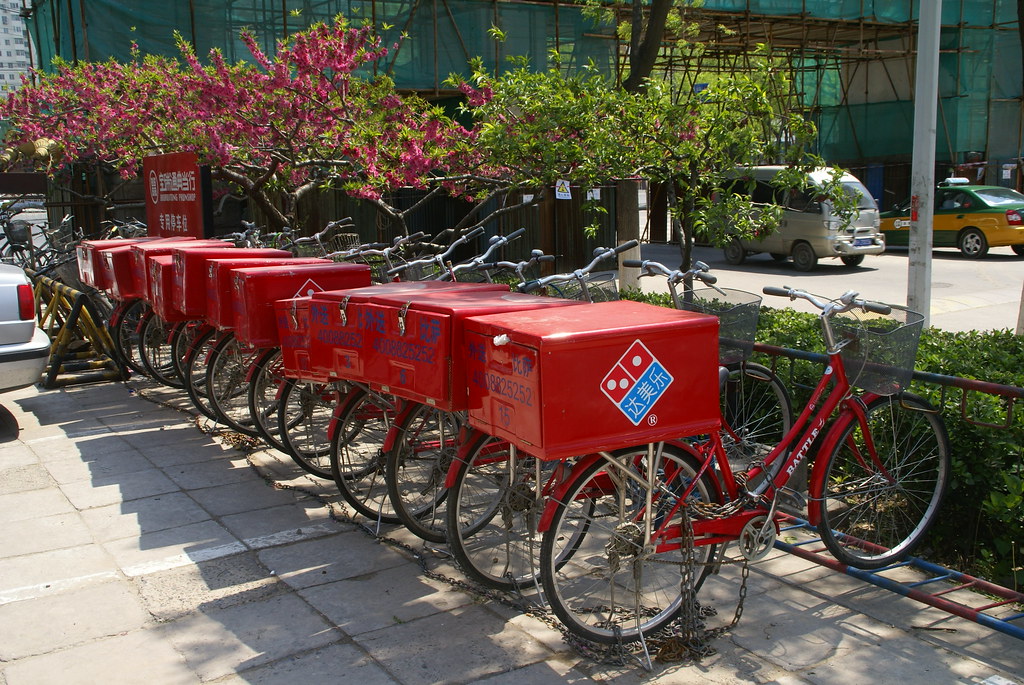
The Pizza-delivery Bike
February 8, 2010
David Byrne Bike Racks NYC
While acting as a judge for a bike rack design competition last year David Byrne - musician, artist and avid New York cyclist - decided it would be a great idea to make his own stamps on the streets of the city. The tongue-in-check street icons were made with their locations in mind. Speaking to the NY Times, Byrne noted “It was important to me that these new racks be the same thickness and material as the existing racks—to help identify them as practical bike racks and not just modern art, the locations about as perfect as one could imagine — Wall Street for the dollar sign and Bergdorf’s for the giant high heel!”
Janette Sadik-Khan, current transportation commissioner has taken on the promotion of cycling in the city as her main priority. “By bringing attractive yet functional sculptures to our streets, we are elevating the profile of cycling, and we believe that more and more people will begin to think about cycling as a mode of transportation, and not just a mode of recreation,” Ms. Sadik-Khan said in a statement. “Regular bike riders have an eagle eye for our current bike racks but these nine installations will capture the attention of all New Yorkers.”
February 5, 2010
Cities for the people | Jan Gehl, Gehl Architects
Jan Gehl graduated from Architecture in 1960, a time to him represents an all time low point in city planning, when architects were big and people were quite small. After marrying a psychologist he started questioning why architecture solely focused on form and did not focus at all on people? For Jan Gehl, Architecture is the interaction between form and life. Cue Jan Gehl’s one stone, five birds policy. If you are sweet to people it is possible to create Lively, Attractive, Safe, Sustainable, and Healthy cities. Modernism, one of the evil of society according to Mr. Gehl, interpreted cities as bad and buildings as good. 1960, the year he graduated was also the year when post-war reconstruction started big time. At the same time there was an invasion on the city ten years after the war, the car invasion. Of course cheap petroleum fuelled this and all the city planner’s energy went into trying to make the car happy. Using Westport, a small town in the west of Ireland as an example, he argues that as a result of the car invasion, human dignity was being eroded. The ideologies of modernity need to be broken.
Labels:
cycling,
jan gehl,
policy,
urban design,
urban planning
February 3, 2010
Why Puma is the best fold-up bike
Combining fashion, fun, functionality and a unique design, this new environment-friendly 8-Speed PUMA Bike will surprise with its amazing color blocking and its retro flair. The Duo Loop Bike features an Easy Semi-Folding Mechanism with rubber on the quick release handle that allows you to take your bike everywhere you wish. An Integrated DT Locking System replaces the down tube and makes the bike unusable for thieves if the wire is cut. The bike also has mechanical twin-disc breaks that provide the ultimate breaking power in stop-and-go city traffic.
Dublin @ 30km/hr circa 1930's
Dublin was a nice city, a civilised city. This of course is before the car invasion of the 1960's. Below are some transport maps and some video footage of Dublin City Centre from the 1930's to prove this. Lets give the new speed limits time to bed it and hopefully, the civilised city that Dublin once was may return.
February 2, 2010
Dublin is one of the worst
Dublin has been ranked 21st out of 30 in a list of the greenest cities in Europe.
According to the Siemens European Green Cities Index, which was compiled by the Economist Intelligence Unit, Dublin is the worst city in Europe in terms of its transport infrastructure.
February 1, 2010
New 30km/h Speed limit in Dublin
AS EXPECTED, motorists have criticised and environmental groups have welcomed the extension of the 30km/h speed limit zone in Dublin city centre. The AA has described the move as a “misapplication” of speed limits that it said other cities had primarily restricted to residential areas. The Dublin Business Association expressed concerns about car-borne shoppers going elsewhere.